
3 Easy Essential Oil Gifts to Make in Your Yoga Classes
Yoga students making aromatherapy inhalers with essential oils during a Deaville Yoga workshop.
One of my favourite ways to end a block of yoga classes is by treating everyone to a simple aromatherapy gift to take home.
We usually make these during the final class of the term. I still want plenty of time for yoga, relaxation and connection, so anything too complicated—like body creams, candles or sewing projects—is firmly off the list.
Over the years I've found three beautiful, quick-to-make gifts that students absolutely love. They're perfect for regular weekly classes, but they also work brilliantly during longer workshops or retreats.
Here are my top three.
1. Aromatherapy Inhaler Sticks
Best time to make them
At the beginning of your final class, or during the middle or end of an aromatherapy workshop once students have explored a variety of essential oils.
You'll need
* Aromatherapy inhaler sticks
* Essential oils
* Optional labels
How to make them
Display all the essential oils you've explored during the course or workshop and invite each student to choose one or two favourites.
If they're choosing two oils, encourage them to smell them together first to make sure they enjoy the combination.
Add 10 drops of essential oil to the cotton wick inside the inhaler.
Click the base firmly into place and it's ready to use.
Blending guide
I generally use the following ratios:
Base note: 3–4 drops
Middle note: 4–5 drops
Top note: 5–6 drops
Example
A calming blend:
Frankincense – 4 drops
Lavender – 6 drops
Did you know?
Aromatherapy inhalers are widely used in supportive healthcare settings, including cancer care, to provide comforting aromas and help manage symptoms such as anxiety or nausea under appropriate guidance.
2. Aromatherapy Rollerballs
Best time to make them
At the beginning of a class, or towards the middle or end of a workshop after students have experienced a range of oils.
You'll need
Empty 10ml rollerball bottles
Carrier oil (I use *80% Sweet Almond Oil** and 20% Jojoba Oil)
Essential oils
Optional Witch Hazel (to clean excess oil from the outside of the bottle)
Small labels
Kitchen roll
A small pouring jug
Remember to check for nut allergies if using Sweet Almond Oil.
How to make them
Fill each rollerball bottle around 90% full with your chosen carrier oil.
Invite students to choose one or two essential oils (three can work, but I usually encourage just two).
Once they're happy with the aroma:
Add *10 drops** of essential oil in total.
Firmly click the rollerball top into place.
Shake well.
Wipe the outside with Witch Hazel if needed.
Add a label.
Blending guide
Base note: 3 drops
Middle note: 4–7 drops
Top note: 4–7 drops
Example
An uplifting blend to encourage energy and focus:
Lemon – 6 drops
Rosemary – 4 drops
Did you know?
Rollerballs make a wonderful natural alternative to perfume and are ideal for applying to pulse points throughout the day.
3. Body Scrub
Best time to make it
At the beginning of a class, or during the middle or end of a workshop. Students love taking these home.
You'll need
Bath salts
Carrier oil
Measuring cups
A clean jar (students can bring one from home)
Essential oils
How to make it
Mix together:
1 cup bath salts
¼ cup carrier oil
20 drops of essential oil
Stir thoroughly and your scrub is ready.
Blending guide
Base note: 6–8 drops
Middle note: 8+ drops
Top note: 8+ drops
Example
This morning we made a simple, gentle scrub for a student with sensitive skin.
We blended:
Sweet Orange – 10 drops
Lavender – 10 drops
Simple, fresh and beautifully uplifting.
Did you know?
This recipe also doubles as a luxurious bath soak or foot soak.
One of the reasons I love this activity is because it's so affordable and easy for students to recreate at home. All they need is bath salts, a carrier oil (olive oil or rapeseed oil from the kitchen work well), and a few drops of their favourite essential oils.
A Few Safety Tips
When making aromatherapy gifts with students, always:
Check for allergies and sensitivities.
Follow the recommended dilution rates for adults.
Avoid oils that may not be suitable during pregnancy or for certain medical conditions.
Encourage students to carry out a patch test before applying a new blend to larger areas of skin.
Final Thoughts
Creating a small aromatherapy gift adds something really special to the end of a yoga course or workshop. It's a lovely way for students to continue their self-care long after they've rolled up their mat, and it's always one of the most memorable parts of the experience.
I hope you've found these ideas inspiring.
If you have any questions about using aromatherapy safely in your yoga classes, or you'd like to learn more about blending essential oils, I'd love to hear from you.
Heather Deavilleheather@deavilleyoga.com
New to Aromatherapy?
Want to use essential oils confidently in your yoga classes?
Whether you're just starting out or looking to deepen your knowledge, my Aromatherapy for Yoga Teachers Course will teach you how to blend safely, choose the right oils for different themes, and confidently introduce aromatherapy into your classes and workshops.
Discover the Aromatherapy for Yoga Teachers Course
Read Next
Essential Oils in Pregnancy Yoga
Teaching pregnancy yoga? Not every essential oil is suitable during pregnancy. In this guide, I explore which oils are considered appropriate, which should be avoided, and how to use aromatherapy safely and confidently in your prenatal classes.
Read my Essential Oils in Pregnancy Yoga blog
Experience It Yourself
Join Me on a Yoga Retreat
Many of the aromatherapy activities in this blog are inspired by my yoga retreats. From creating personalised inhalers to mindful blending sessions, they're a beautiful way to help students slow down and connect with themselves.
If you'd love to experience yoga, nature and aromatherapy together, I'd love to welcome you on one of my retreats.
Why I Love Teaching Toddler Yoga
Mini Movers Toddler Yoga
Toddler yoga is one of the most joyous classes you will ever teach. But how did I get here, and what can I share with you on your own journey?
My Journey
In 2017, I became a certified pre and postnatal yoga teacher, thanks to the fabulous Sally Parkes. It had been my dream from the very start of my yoga teacher training to support women through their pregnancies, birth, and beyond — and this training became the foundation for nearly a decade of teaching what I love.
I immediately fell in love with Mum & Baby Yoga. I taught it with my own youngest child, and although he had to "retire" at 7 months (the moment he started crawling), I taught this class three times a week, and it always brought me such joy. Sally then invited me — or, more honestly, I think I pestered her into it — to assist on the Pre & Postnatal YTT and lead the Mum & Baby Yoga module. I've been reveling in this role for many years, and many of you reading this may know me from there.
But when the babies started crawling, just like my little one did, the class stopped working — for mum or baby. So I trained in pre-school yoga and created the class so many of my mums were asking for: the one that comes after Mum & Baby Yoga. I now call it Mini Movers.
Over the years of teaching, I perfected and honed my classes. I was always determined to bring in as much yoga for mum as possible, while introducing yoga to the kids through story, dance, music, song, and play.
When I moved house a year ago, I met a wonderful teacher called Kate. She was already teaching toddler yoga locally, and our timetables clashed — so I finally decided to do what so many of you have been asking me to do for years: write a 30-hour CPD training so you can take this work back to your own communities and teach it with joy.
It's been a six-month journey, during which I've deepened my own knowledge and risen to the challenge of putting everything you need into one training — everything you need to teach these classes successfully.
Whether in your own classes, in studios, or in nurseries and pre-school settings, helping to fill those "dead" yoga hours of the day, my Mini Movers Training has finally arrived. I believe it's exactly what you need to take the next step in your yoga teaching journey. The first cohort trains this autumn, with one day online (Sun 27th September) and two days in person at Jing Studio, Central Brighton (Sat 3rd, Sun 4th October).
Numbers will be limited to ensure everyone gets the support they need to leave the training ready to teach.
I would love you to join me
If this story resonates with you — if you've taught Mum & Baby Yoga and watched your littlest students start to crawl their way out of your class, or if you've simply been waiting for a joyful, well-structured way to bring yoga into nurseries and pre-schools — Mini Movers was created for you.
Spaces in the first cohort are limited, and early bird pricing closes soon. 👉 Find out more and join the waitlist I can't wait to share this wonderful style of yoga with you. Heather x
Chakra Yoga Series: Part 7, Crown Chakra
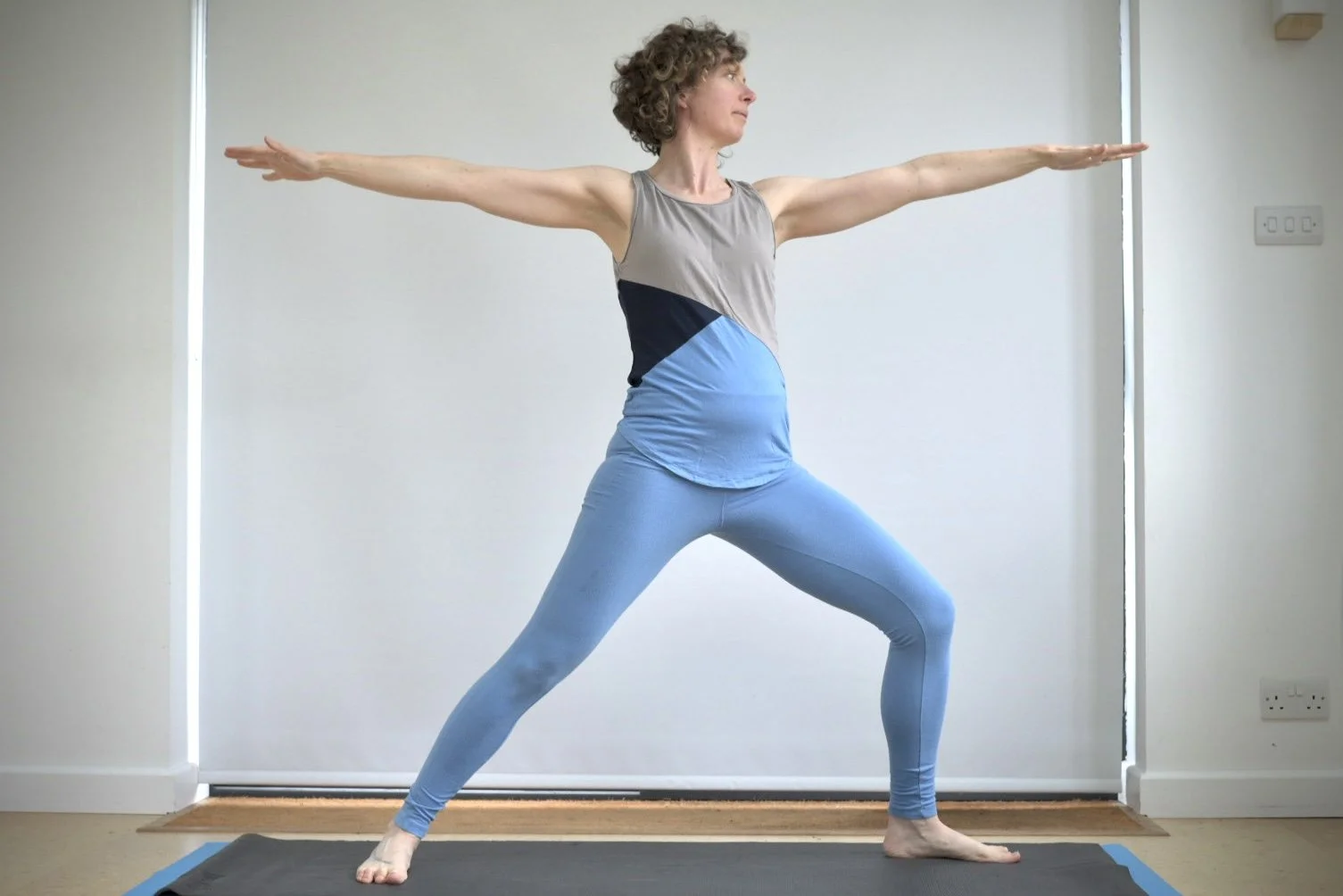
Yoga Teacher in Warri II pose
As we arrived at the final week of our journey through the chakras, we reached the Crown Chakra, Sahasrara. And yet, in many ways, this is not an ending at all, but a beginning.
Going deeper into stillness
This week we continued in the same direction as our exploration of the Third Eye Chakra, moving further into stillness. We softened mental chatter, created space, and allowed ourselves time to reconnect, not only to our intuition, but to a wider sense of awareness and connection to all living things.
To support this journey, we began back at the Root Chakra. In many ways, the Crown Chakra invites us to reflect on the entire chakra system. When the chakras are balanced, we begin to feel both an inner steadiness and an outer connection to something greater than ourselves.
Root to rise
“Root to rise” is a familiar phrase in yoga, but this week it truly came alive in our practice.
We began with grounding, pelvis-focused movements, building awareness from the base upwards. As the weeks have unfolded, I’ve found myself offering fewer verbal cues, one of the joys of working with the same students over time. With less instruction, there is more space for students to feel, explore, and trust their own experience.
Our connection to the earth felt strong and steady. We moved through:
Bridge Pose
Flowing Cat–Cow
Mountain Pose
Dolphin Pose
Warrior II
Extended Side Angle
Eagle Pose
As with our Third Eye practice, we returned again and again to our Drishti, our focused gaze. The energy in each class felt calm and grounded, yet quietly powerful—soft, steady, and deeply present. The stillness of mind was something you could almost feel in the room.
Essential oils
We began the practice with Elemi essential oil, a resin-based middle note known for its grounding and regulating effect on the nervous system. It helps to ease stress, clear the mind, and support clarity and focus. It was exactly what was needed as we settled into practice.
We closed with Frankincense essential oil, an oil long associated with spiritual connection, tranquility, and contemplation. Its deeply calming effect on both body and mind made it the perfect companion for our final meditation and savasana.
Mudra and mantra
This week we explored Atmanjali Mudra, often described as a gesture of greeting the self. It carries a quiet sense of reverence and inner acknowledgement.
We paired this with the mantra:
“Tranquillity and inner wisdom characterise my life.”
Throughout the practice, we also worked with the awareness:
“I am the observer of my thoughts and do not let them bring me down.”
And in meditation:
“In the silence, I am open to receive without asking and without expectation. In the silence, I will see and hear the truth.”
Where next?
As I reflect on this journey through the chakras, I feel a strong pull to continue exploring this work more deeply with my students. Rather than keeping each chakra separate, it feels like the right time to begin weaving them together, as they are naturally intended to be.
So next week, we’ll begin a new chapter: a journey through all seven chakras as one integrated practice. It feels exciting, expansive, and full of possibility.
Exploring each chakra individually has been a fascinating experience, both for me as a teacher and for my students. Many have shared how much they’ve enjoyed the process: taking their practice to a deeper level, exploring something new, and stepping beyond their comfort zones with curiosity and openness.
I hope this journey has inspired you to explore the chakras for yourself. And if you’re a yoga teacher, perhaps it might encourage you to create your own Chakra Yoga series. If you do, I would truly love to hear about your experience.
Thank you so much for reading, and I hope to see you back here again soon.
If you’ve enjoyed following this Chakra Yoga journey and feel called to explore it more deeply, you’re so welcome to join me.
I offer regular yoga classes, workshops, retreats and CPD training for yoga teachers who want to integrate essential oils into their teaching in a safe and meaningful way.
👉 Get in touch, I’d love to hear from you heather@deavilleyoga.com
Sources and Inspiration
The themes explored in this class were informed by my own knowledge of traditional yoga philosophy and practice. My experience as a professional aromatherapist and inspiration from:
Anodea Judith’s Chakra Yoga, published by Llewellyn Books
Aromatherapy for healing the spirit, Gabriel Mojay, published by Healing Arts Press
Mudras for Body, Mind & Spirit by Gertrud Hirschi, published by Tarotdeck
The Power of the Chakra’s, Fiona Toy, published by Hinkler
These sources often inform the framework I use when designing themed yoga classes that integrate movement, breath, subtle energy and essential oils.
The Chakra Yoga series:
You can explore the whole series so far by following these links to my chakra yoga blogs for each one:
Week One: The Root Chakra
Week Two: The Sacral Chakra
Week Three: The Solar Plexus Chakra
Week Four: The Heart Chakra
Week Five: The Throat Chakra
Week Six: The Third Eye Chakra
Week Seven: You’re here
Chakra Yoga Series: Part 6, Third Eye Chakra
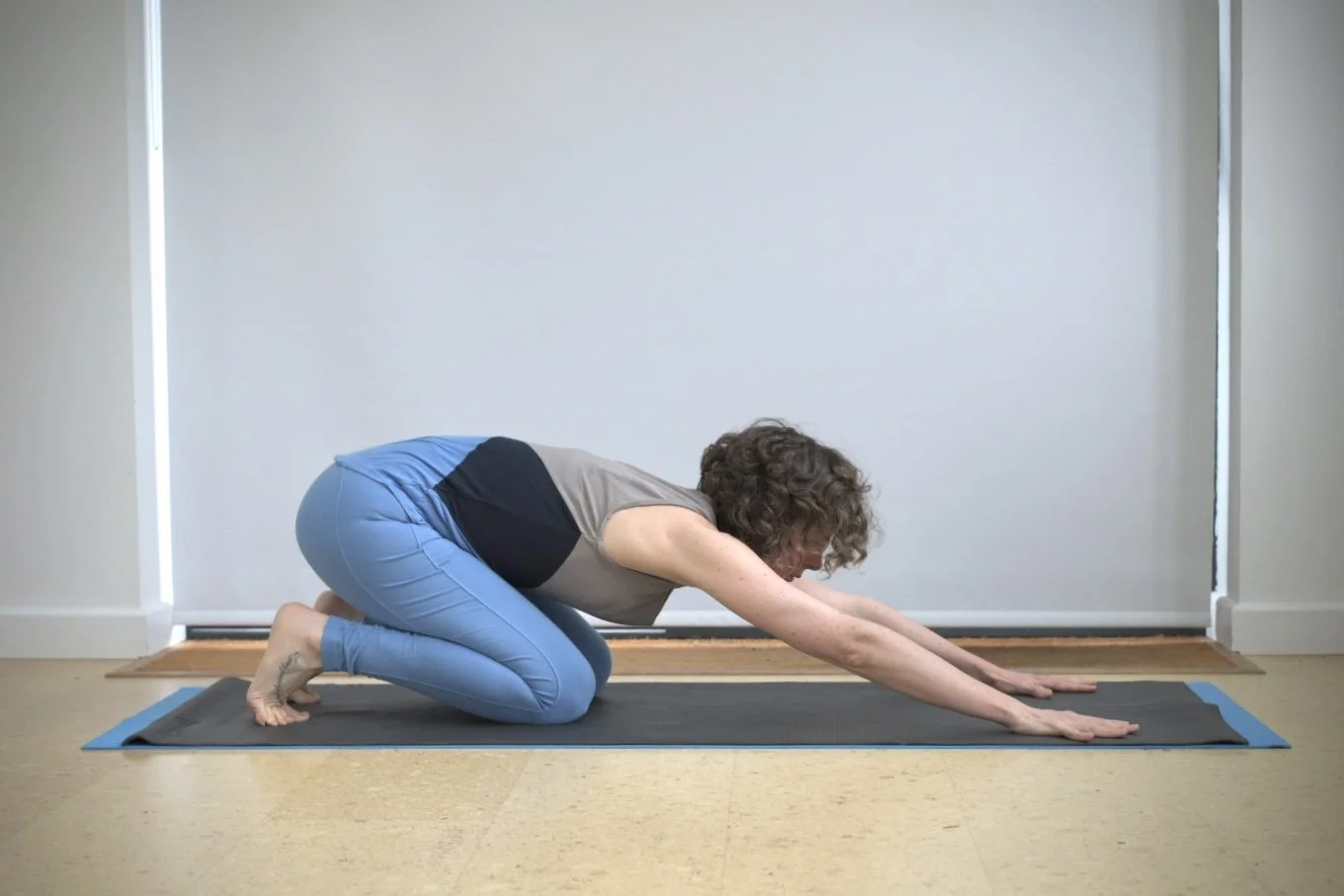
Yoga teacher making her way to Puppy Pose
As we reach week 6 of our Chakra Yoga journey, I can feel the energy settling into a quieter, more meditative space. Having moved through more outward-facing energetic themes, our attention now turns inward to the Third Eye Chakra, Ajna. This practice invites us to trust our intuition and listen deeply to our inner wisdom.
Focus on our focus
In this week’s classes, we worked with both our internal and external gaze. This simple shift helped to quiet the mind and deepen our ability to listen to ourselves.
In yoga, this focused gaze is known as our Drishti. We gently anchor our awareness to a single point, allowing the eyes to be steady yet soft. This steadiness supports us in balance postures and encourages a calmer, more settled mind in stillness.
The inner eye
The Third Eye Chakra is considered the seat of intuition. Located just above and between the eyebrows (and slightly deeper within the centre of the head), it is often described as a form of inner knowing and connecting to a higher, more spiritual realm.
Like the Heart Chakra, its guidance is clearest when we pause long enough to truly listen. This week we explored that space by slowing the breath and visualising calm, expansive imagery, spaces that felt vast, open and still.
One image that resonated strongly was standing at the edge of the ocean, watching sunlight dance across the water. In teaching, I also chose to speak less at times, allowing more silence for students to fully inhabit their practice.
The physical practice
Our asana practice supported this inward focus through postures that encouraged steadiness, space and awareness:
Extended Puppy Pose
Warrior III
Revolved Side Angle Pose
Downward Facing Dog
Each shape offered an opportunity to return to the breath and gently refine attention.
Mudra and mantra
This week I really enjoyed sharing Shankh Mudra (Shell Mudra) with students. In this mudra, the fingers interlace to form a shape reminiscent of a conch shell, symbolising the connection between outer expression and inner truth.
It is said to support inner listening and deepen connection to intuitive knowing. The right thumb is gently held, representing the “pearl of wisdom” protected within.
We closed with the affirmation:
“I trust my instincts and follow their guidance.”
Essential oils for the Third Eye
We began our practice this week with Clary Sage essential oil. This oil supports reconnection with intuition, helping to clear the mind and leaving us feeling revitalised and re-inspired.
We closed the practice with Amyris essential oil, a gently uplifting oil that helps calm and clear the mind while supporting a quiet sense of wellbeing and inner ease.
Join me for a class, workshop or CPD training
My joy is in sharing my two great passions—yoga and aromatherapy—and I would love to have you join me on this journey.
I teach yoga classes in Sussex, run yoga workshops, and Yoga retreats across Sussex and Kent.
I am also blessed to have a wonderful community of yoga teachers who have completed my Essential Oils for Yoga Teachers CPD training. They are passionate about learning how to safely and meaningfully incorporate essential oils into their classes and workshops.
Next week
Next week we’ll journey up the Sushumna Nadi to the Crown Chakra, Sahasrara, building on our exploration of inner knowing while gently expanding into our connection with the world around us and the divine.
Sources and inspiration
The themes explored in this class were informed by my own knowledge of traditional yoga philosophy and aromatherapy, as well as inspiration from:
Chakra Yoga by Anodea Judith (Llewellyn Publications)
Aromatherapy for Healing the Spirit by Gabriel Mojay (Healing Arts Press)
Mudras for Body, Mind & Spirit by Gertrud Hirschi (Findhorn Press)
These sources often inform the framework I use when designing themed yoga classes that integrate movement, breath, subtle energy and essential oils.
The Chakra Yoga series
You can explore the full series so far below:
Week One: The Root Chakra
Week Two: The Sacral Chakra
Week Three: The Solar Plexus Chakra
Week Four: The Heart Chakra
Week Five: The Throat Chakra
Week Six: You’re already here!
Week Seven: Coming April 24th 2026
6 Essential Oils for Hormone Balance & Emotional Support in Yoga Classes
6 Essential Oils Yoga Teachers Can Use for Hormone & Mood Support in classses.
6 Essential Oils Yoga Teachers Can Use for Hormone & Mood Support
As a yoga teacher and aromatherapist, I’m a big believer in taking a holistic approach to the different stages of a woman’s life. Hormonal shifts, whether during perimenopause, times of stress, or emotional transition, can affect sleep, mood, energy and focus.
One gentle and powerful way to offer support in your yoga practice or classes is through essential oils.
If you’re a yoga teacher wanting to incorporate aromatherapy safely into your classes, this guide will introduce six beautiful oils that can support hormone balance, emotional wellbeing and nervous system regulation.
Essential Oil Safety for Yoga Teachers (read full advice here)
Before using essential oils in yoga classes, safety is essential.
Do not take essential oils internally.
Do not apply oils neat to the skin — always dilute in a carrier oil (sweet almond oil is ideal; even rapeseed oil works).
Check contraindications for each oil.
If you or your students are on medication, advise them to consult their GP before use.
The safest and most accessible way to use essential oils in yoga classes is aromatically through inhalation.
Simple methods include:
One drop on a cotton pad for individual use
Personal inhalers
Diffusing oils in a well-ventilated space
Inhalation allows the aromatic compounds to interact directly with the limbic system of the brain, having an immediate impact on our bodies, minds and souls.
1. Bergamot – For Uplifting Low Mood
Bergamot is a beautiful citrus oil that feels both uplifting and gently energising.
It’s ideal for:
Low mood
Fatigue
Emotional heaviness
In a yoga class, bergamot works beautifully at the beginning of practice to shift stagnant energy and create lightness in the room.
2. Rose – For Self-Compassion
Rose is often called the oil of self-love.
During hormonal transitions, many women feel disconnected from themselves. Rose supports heart opening, compassion and emotional processing.
This oil pairs beautifully with:
Women’s circles
Restorative yoga
Heart-opening sequences
Even one drop on a cotton pad during savasana can create a deeply nurturing experience.
3. Vetiver – For Sleep & Deep Grounding
If sleep is disrupted due to hormonal shifts, Vetiver is incredibly supportive.
It’s earthy and grassy in scent, so if you find it too earthy I recommend blending one drop with:
Geranium
Lavender
Vetiver is excellent in:
Yin yoga
Evening classes
Grounding meditations
It helps anchor scattered energy and calm an overstimulated nervous system.
4. Rosemary – For Brain Fog & Focus
Hormonal changes can affect clarity and concentration.
Rosemary is stimulating and sharpening — wonderful when you need mental clarity.
Use it for:
Morning classes
Workshops
Teacher trainings
Study sessions
It pairs well with pranayama or focused standing sequences.
5. Roman Chamomile – For Soothing Heat & Tension
Roman chamomile is deeply calming.
It helps release:
Emotional tension
Irritability
Internal “heat”
This oil supports parasympathetic activation and is ideal in:
Restorative yoga
Breathwork practices
Closing relaxation
6. Rosewood – For Energetic Boundaries
Rosewood is less commonly spoken about but beautiful for emotional protection.
For teachers holding space regularly, this oil can:
Support energetic boundaries
Preserve your own energy
Reduce emotional depletion
It’s a wonderful oil to use before teaching or during retreat facilitation.
Other Essential Oils for Hormonal & Emotional Support
Other oils I regularly use in women’s yoga classes include:
Clary Sage
Frankincense
Benzoin
Lemon
Tea Tree
Sandalwood
When thoughtfully integrated, aromatherapy can deepen your students’ sensory experience and support nervous system regulation within your yoga classes.
Choosing High-Quality Essential Oils
If you’re purchasing essential oils in the UK, I use oils from Base Formula, Natural Health Remedies and Neal's Yard Remedies (not affiliated).
Always prioritise organic and ethical sourcing where you can. In my experience you get a much nicer oil this way.
Integrating Essential Oils Into Your Yoga Teaching
Essential oils can:
Deepen savasana
Enhance themed workshops
Support women navigating hormonal shifts
Create a more embodied sensory experience
When used safely and intentionally, aromatherapy becomes a powerful extension of your teaching — supporting both emotional wellbeing and nervous system balance.
If you’d like to learn how to confidently and professionally integrate essential oils into your yoga classes, retreats or workshops, explore my essential oils training and CPD options.
Let’s grow happier, older and wiser — together.
Love and hugs as always,
Heather ✨